
The best way to pack books for moving
get a free quoteThe safest way to pack books is to use small, reinforced boxes, keep each load manageable, arrange books according to size and condition, and fill gaps so nothing shifts. Standard books can stand upright when supported, while oversized, fragile, or weakly bound books should lie flat and receive extra protection. Clear labeling, early sorting, and professional help for large or valuable collections reduce damage and make the move easier to manage.
The best way to pack books for moving is to use small, sturdy moving boxes, reinforce each bottom with three strips of packing tape, arrange books according to their size and condition, and fill open spaces so nothing shifts. When learning how to pack books for moving, choose compact book boxes rather than large household cartons and keep each finished box below 50 pounds—or lighter when stairs, long carries, or difficult access are involved.
Why do books need special packing?
Books are dense, so a large box can become difficult to lift before it is full. An overloaded carton may split along the bottom seam, collapse when stacked, or block the carrier’s view. Inside the box, unsupported books can slide into one another, bending covers, loosening bindings, and tearing pages. Understanding how to pack books correctly reduces each of these risks.

A compact book box measuring about 12 by 12 by 12 inches is easier to control than a large moving carton. Using sturdy boxes and quality packing supplies Cincinnati companies provide also protects fragile bindings. Labeling each box by room, shelf, or category gives every book a clear destination during unpacking.
What supplies do you need to pack books for moving?
Gather all materials before removing books from the shelves. Having the correct supplies ready is an important part of how to pack books for moving because it prevents partially packed boxes from being left open and exposed to dust, spills, or moisture.
| Supply | Best use | Important caution |
|---|---|---|
| Small, sturdy boxes | Books and other dense items | A compact box around 12 × 12 × 12 inches is easier to carry |
| Packing tape | Reinforcing bottoms and seams | Never place tape directly on a book |
| Packing paper | Filling side and top gaps | Use clean, dry, ink-free paper |
| Bubble wrap | Albums and fragile editions | Never seal a damp book in plastic |
| Acid-free paper | Rare, signed, or collectible books | Place it directly against valuable covers |
| Labels and markers | Recording the room, shelf, and box number | Write on the box, not the book |
If you have several bookcases or valuable editions, a professional packing service in Cincinnati can supply boxes, wrap fragile volumes, label cartons, and prepare the collection for loading.

What is the best way to pack books for moving step by step?
Begin packing decorative, reference, and rarely used books two to four weeks before moving. Keep schoolbooks, work materials, and current reading accessible until the final week. Following a consistent sequence makes how to pack books much easier to manage across a large collection.
- Sort and organize the collection. Divide books into keep, donate, sell, and discard groups. Pack one shelf at a time and group the books you are moving by room, category, size, or shelf order.
- Choose small, dry boxes. Inspect every carton for tears, crushed corners, softened cardboard, stains, and moisture. Do not use boxes that previously held food, chemicals, or damp items.
- Reinforce the bottom. Seal the center seam with one strip of packing tape. Add two more strips across the bottom in the opposite direction, then check the corners before filling the box.
- Arrange books by size and condition. Small and medium books may stand upright when similarly sized volumes support them. Place large, heavy, oversized, or weakly bound books flat. Never force a book into a gap that bends its cover.
- Fill open spaces. Use smaller books only where they provide support without creating pressure. Add crumpled packing paper along the sides and top until the contents remain in place when the box is gently tilted.
- Keep the load below 50 pounds. Test-lift the box before sealing it. Make it lighter for stairs, long walks, poor handholds, or narrow hallways. Divide any box that feels awkward or blocks your view, and use a dolly for several cartons.
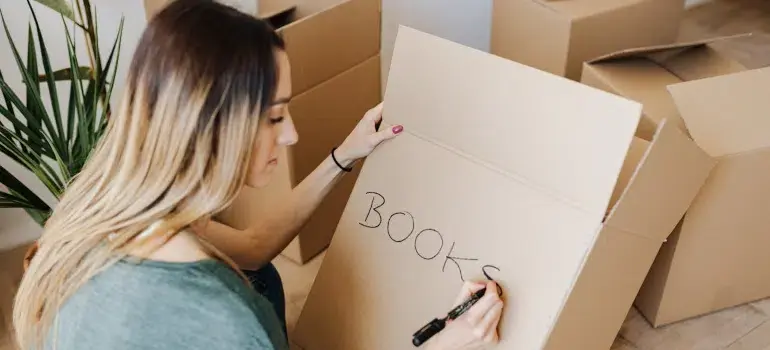
- Seal and label the box. Tape the top seam and write “Books,” the destination room, the shelf or category, and a box number. Add “Heavy” or “Handle Carefully” where appropriate.
This process explains how to pack books for moving while keeping cartons stable and giving movers clear handling instructions. Pairing careful packing can make moving less stressful and also keep the rest of moving day organized.
Should books be packed flat or upright?
Pack small and medium hardcovers or paperbacks upright when books of similar height support one another, as they would on a shelf. Place coffee-table books, albums, atlases, and books with weak or damaged bindings flat. Keeping books grouped is the best way to efficiently pack for your move, since an even arrangement reduces empty space without placing pressure on covers. Anyone deciding how to pack books should avoid sharp leaning, unsupported page edges, bent covers, and rows packed so tightly that the bindings bow.
How do you pack different types of books safely?
Match the packing method to the book’s construction and condition. Understanding what packing materials are worth buying is especially important for rare, decorative, or oversized editions that need more protection than standard paperbacks.
- Hardcovers – Group books of similar height and keep them straight. Place clean packing paper between decorative, cloth, or easily scuffed covers.
- Paperbacks – Align the cover edges and fill shallow gaps with paper. Do not wedge thin paperbacks between much heavier hardcovers.
- Rare or collectible editions – Handle them with clean, dry hands and wrap each one in acid-free paper. Photograph the front, back, spine, and existing damage, then record the title and box number in a simple inventory.
- Oversized books or albums – Place them flat in a separate or padded box. Support all four corners, keep the full book inside the box, and avoid stacking heavy volumes above it.
These distinctions are essential when deciding how to pack books for moving, since a paperback, a heavy atlas, and a fragile signed edition should not receive identical treatment.
What are the most common mistakes when packing books?
Avoid these errors when preparing and loading book boxes. Many moving hacks that save time and stress also begin with preventing overloaded, unstable, or poorly labeled cartons before moving day.
- Using oversized boxes – Large cartons can exceed a manageable weight before they are full.
- Packing books without support – Sharp leaning and bent covers can distort bindings.
- Skipping protection for rare editions – Valuable books need individual wrapping and a box inventory.
- Leaving boxes unsealed – Open cartons expose books to dust, spills, and moisture.
- Using damp or weak cardboard – Soft boxes can collapse and transfer moisture to the contents.
- Forcing books into tight rows – Excessive pressure bends covers and strains bindings.
- Leaving large empty spaces – Books can slide and collide during braking and turns.
- Loading book boxes too high – Place them on the truck floor or in the lowest stable layer, never above lamps, glassware, or lightly packed cartons.
Knowing how to pack books also means checking that every box is dry, fully sealed, clearly labeled, and stable when lifted before it enters the moving truck.
What should you do with books you no longer need?
Sort unwanted books two to four weeks before moving so there is time to rehome them. Keep the titles you use, donate clean books in good condition, consider selling books that may have collectible value, and recycle badly damaged books where local rules allow. Keep one clearly labeled box of schoolbooks, work materials, current reading, or children’s favorites accessible until moving day.

When should you hire professional packing help?
Professional help may be useful when a collection fills several bookcases, includes signed or fragile editions, or requires dozens of boxes to be carried down stairs. Ready 2 Roll Moving helps Cincinnati customers who are unsure how to pack books prepare cartons, wrap vulnerable volumes, label boxes, carry heavy loads, and organize them for transportation. When comparing providers, choosing the right moving company helps protect both the books and the rest of the household.
How can Ready 2 Roll Moving help with your book collection?
Ready 2 Roll Moving provides packing, lifting, loading, and transportation assistance for Cincinnati households moving book collections. Customers comparing moving companies Cincinnati Ohio can request an estimate based on the number of bookcases, the amount of packing required, the home’s stairs and access, and the moving distance. For customers with several shelves, valuable editions, or difficult access, professional support can provide the best way to pack books for moving without overloading boxes or risking avoidable damage.
The best way to pack books for moving
Yes. A hard-shell rolling suitcase can hold heavy or oddly shaped books and makes them easier to transport. Check the suitcase’s weight limit, distribute the books evenly, and add soft padding to prevent shifting.
Plastic bins provide better protection from brief exposure to moisture, but they can become very heavy. Use small bins, make sure every book is completely dry, and avoid sealing books in plastic for long-term storage.
Yes. Shipping books separately may be practical for a small collection or a long-distance move. Compare shipping charges, delivery times, insurance limits, tracking, and the cost of adding the books to your household shipment.
Keep boxes in a cool, dry, temperature-stable area away from direct sunlight, plumbing, exterior walls, and concrete floors. Raise cartons on shelves or pallets and inspect the storage area for moisture, insects, and mold.
Remove loose dust with a clean, dry, soft cloth or brush before packing. Do not use water, household cleaners, oils, or sprays, especially on leather, cloth, rare, or collectible covers.
Use clean boxes, inspect books for insects before packing, and keep food away from the storage area. Avoid mothballs or pesticides inside book boxes because their chemicals and odors may damage paper, covers, and adhesives.